

Categories
Awesomeness in the World Karen

Instant or Gradual Change?

OLYMPUS DIGITAL CAMERA
Photo Credit: Jeff Sheldon

Here’s a question: Think of an area of personal conduct that, when expressed, you later regret and/or know is not how you really want to be.

For me, it’s assuming I know what’s going on or what people are thinking when there is silence.

This has been a life-long nuisance. I want to not jump to conclusions when I experience “silence” from an individual. But, it’s something I still struggle with. As I look back I can see progress; but it’s slowwwww progress. Yes, I’m better today than I was 10 years ago, but dang, sure wish I would grow in this area in leaps and bounds. Nope. It’s a slow journey. Yes, I’m moving forward, which is the most important part, but nonetheless, slow.

Growth is gradual. Often, we desire and want immediate change. It’s fun to experience instant change in how we view life, how we relate to life, and how we conduct ourselves in life.

Think of a metaphor that exemplifies gradual growth or change. For example, a river creates gradual change. When a river shifts its bed, it begins to manipulate and erode the land to fit the new course.

Other examples of gradual change can be a seed to an oak tree, a baby to an adult, a university student to a CEO – each morphing in its due time. Bodybuilders and athletes understand the discipline of gradual change. Even rocks change with time!

What truly remains the same? What never alters or changes in pattern? Try to come up with one thing that won’t change at some point in time. Chances are, you will not find an example that depicts absolute dormancy. Without being too morbid, even a decaying body will eventually turn back to dust.

What about instant or unpredictable change? Things like a tornado, a car accident, being laid off work, winning the lottery, falling in love.

Gradual change and instant change both carry a different form of impact. We say we want immediate change, but do we really want it?

What are the contrasts of instant and gradual change? One is slow & probable; the other is sudden and startling.

What are some negative experiences we associate with gradual and instant change? With gradual change, it is common to experience impatience because it’s going too slow, insecurity because we are unclear of where ‘this’ is going. It can create doubt.

With instant change, it’s common to be unprepared for its immediate impact. It can have a dramatic affect on how we relate to our environment, and it can also create different levels of distress.

What are some positive experiences we associate with gradual and instant change?

With gradual change, we might experience introspection and contemplation. We might be more evaluative and measure our progress, and we will have a calmer and simplified process with the change.

With instant change, we might have a life-changing experience. It can push us to make a decision and not procrastinate, and it helps create new thinking.

What would be your answers?

So, where am I going with this?

Don’t be so hard on yourself if you don’t see immediate results when you desire change. Take inventory of your life. If you look back ten years, do you see any change? Never underestimate the small victories and accomplishments, even if they seem minute. Celebrate it!

If, in reflecting, you don’t see the change you hoped for, embrace the journey of gradual change. Just like a river, it is a beautiful thing to watch a current transform landscape. You are just like that river. And your landscape welcomes the change. It’s just that sometimes, it takes time. And that’s okay, because time is your friend.

– Karen Thrall

* also published on www.karenthrall.com
Categories
How to be Awesome Jams Libby

Inappropriate Children’s Songs

Every parent finds themselves uncomfortable with a song their child has heard or gravitated to…they can be a source of questions that are particularly difficult and embarrassing to answer. I am no different, but here is a list of songs that my seven year old son has either misheard or misinterpreted the lyrics. Try listening to them with an alternative take in mind…you’ll get a giggle!

  1. Another One Bites the Dust [Queen] Okay, so I don’t know for sure, but believe this song is about gang riots or something…really not appropriate for a kid, but try not laughing when he earnestly sings “Another One Busts the Dust.” A vacuum cleaner is something we really don’t celebrate enough, right?
  2. Sugar [Maroon Five] The innuendo in this song is ridiculously inappropriate for children, but the literal ode to sweetener is totally appropriate for a seven year old. It’s a true love, a pure love. Delicious.
  3. TNT [AC/DC] This is another song that has a level of innuendo that is difficult even for adults to embrace (!), but when Joey sings it, it becomes a personal power anthem. Power is something that a kid has very little of, so having a way to articulate it is an awesome thing to watch.
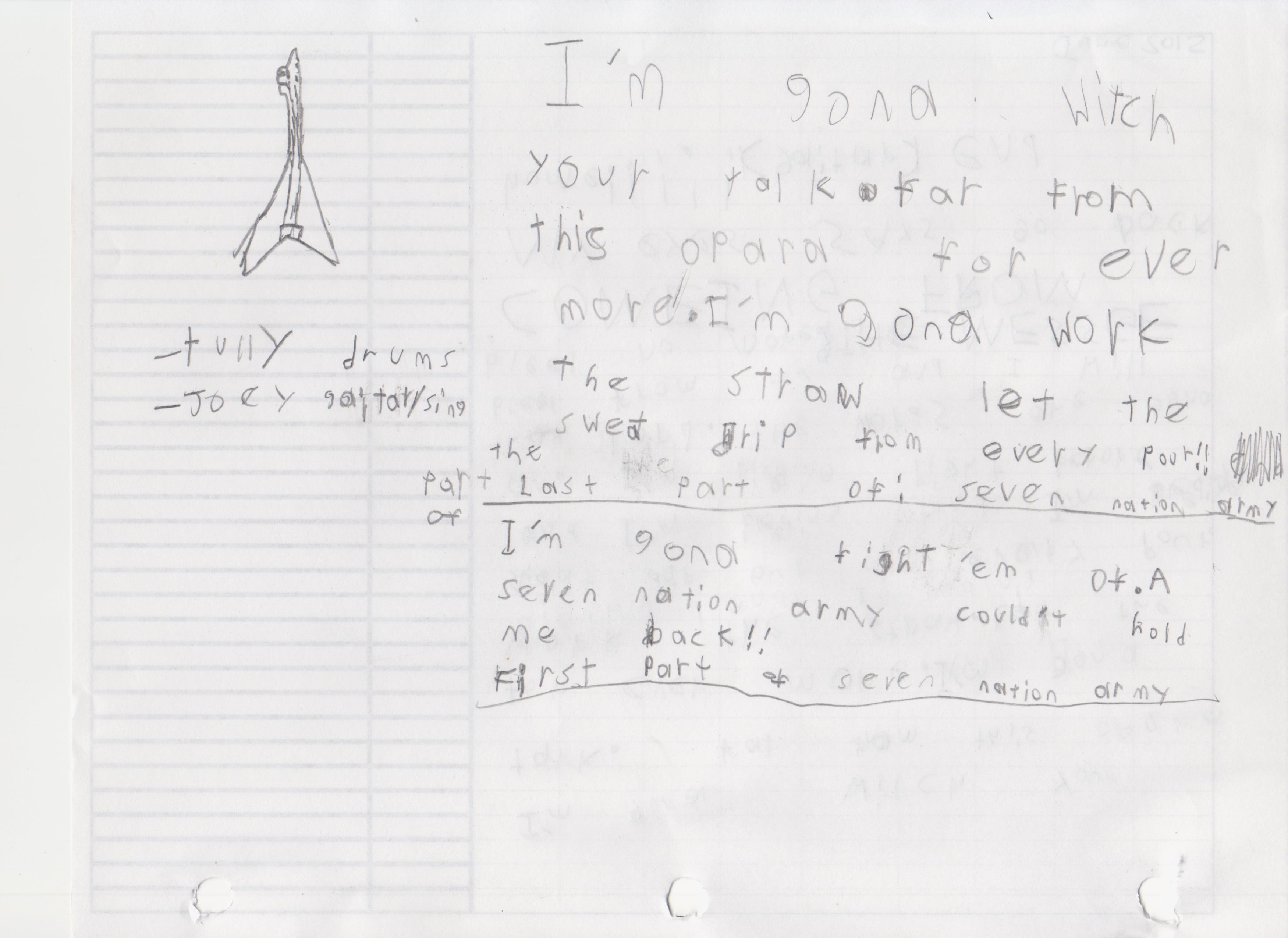
  4. Seven Nation Army [White Stripes] Joey is learning how to play the guitar and this is his go-to song. Honestly, I’m not sure what the song is about (other than it is a play on the Salvation Army), but I don’t really care. Why? Because Joey has no idea what the words are and what it means – all I know is that he loves to sing it when playing the guitar and that it’s adorable. And on top of that, he has written out the lyrics for when he and his eight year old cousin form their band this summerLibby Post
  5. You Can’t Always Get What You Want [Rolling Stones] I love it when Joey says, “Mom! This is my theme song!” We have used this as a mantra to avoid temper tantrums when he was little, and now he’ll actually ask us for what he might “need” if he can’t get what he wants. Rockin’ AND effective!

– Libby Bingham

Categories
On the Job

Celebrating: It’s Serious Work

Last Friday, I was fortunate enough to be part of an amazing team celebration. This is a group I’ve been facilitating and they’ve accomplished some amazing work over the past year. It’s a smallish team of a dozen or so folks who have worked closely together on beginning to shift their organizational culture. And I say beginning not because they weren’t effective or didn’t finish what they started, but because culture work is a long, long, long road (did I mention it’s a long process?). It was a great group, though that’s not to say we didn’t have our bumps and bruises along the way. Culture gets to the very thing we all hold near and dear – our values. And conversations about our values and what we value in the world are incredibly personal. They can’t be anything else, especially if they’re honest. But through those bumps and bruises, this team got to know one another in a way that they hadn’t had the chance to before. The result was incredible – a high-performing team who worked made significant progress and genuinely enjoyed each other.

When it came time for us to wrap up our work together, we had a couple things we needed to do. One, we wanted to review our work from the past year and make sure we’re setting up the next iteration of the team for success. Two, we wanted to take stock of exactly what we had accomplished and the impact it had. Often times, you can’t see the progress you’ve made while you’re in the middle of it, but once you stop to look back as see how far you’ve come, it’s incredible. And finally, in the middle of sharing advice and taking a look at what we’d done, we really needed to celebrate. I believe celebrating is both the most important component to a team’s progress and the most often overlooked step. And with this team, it was simple. The team really valued each other, which made planning the celebration easy.

We had a more formal wrap-up meeting the office, but then we got off campus for a good ol’ fashioned happy hour celebration. While happy hour is usually fun, this one was special. This was a group of people who were not just willing, but excited, to spend their Friday night together. After a long week in the office, this team valued each other so much that once the work week was officially done, they still chose to spend their time together.And that’s amazing to me. I feel honored to have been a part of this team and they’ll always have a special place in my heart for that very reason.

Celebrations don’t have to be big and elaborate to be meaningful. Celebrating can be a hand-written note, a cup of coffee, a small gathering of friends or an end of the week happy hour. What’s most important is that you make the time for that celebration, whatever it may be. What do you need to celebrate today?

Categories
On the Job

The Power of One Word

Earlier this week, Libby and I taught a course on facilitation for the American Society of Association Executives (ASAE). It was a great group of engaged and thoughtful participants. If you’ve read any of my posts, you know my favorite part of all the sessions I do are the gems from the attendees – the power that comes from a group of people willing to share their thoughts and experience is truly amazing. And this session was no exception. While we were sharing tips and tricks, one of the attendees shared her one word exercise. It’s simple and can be used at any point during a meeting: each attendee shares one word to sum up their thoughts. It can be a feeling about where the project is, an item to suggest for the next agenda, a thought on the how the meeting went…you get the idea.

I love this tool. I used to volunteer for a suicide hotline and in the training of new listeners (that’s what the hotline volunteers were called), we focused heavily on empathy and feelings, and this was one of the tools we used. At the end of each training session (and some of them were pretty intense, as you can imagine), each listener had to share one feeling word to sum up where they were in the process. We heard a lot of nervous, anxious, apprehensive, excited, overwhelmed and so on. It helped us as trainers get a sense of where the trainees were in their journey, and it also helped us all practice using feeling words. Having to select only one word really made us all focus. We all had a lot of reactions, thoughts and feelings during a session, but being forced to narrow it down to one word really made you think. Very often, I was energized by the team in the room and the commitment they’d made to be there. I was hopeful for our community, given the number of people who chose to spend their time this way. And I was grateful to be a part of it all.

Bring reminded of that exercise earlier this week has reinvigorated me and put me into a different head space. What’s the one word I want to describe my day today? This meeting? This interaction? How do I want to feel about where I’m at? How I’ve spent my time? And what can I do to influence the one word people would say about their interaction with me? These are powerful questions and I encourage you to take the one word challenge. What do you want your one word to be?

Categories
Ashley On the Job

Email Hell

You guys, I’ve had writer’s block. What makes it so awful is I’m not even a writer! How can this be?! I mean, I like to think I’m sort of an amateur writer with a few decent stories to tell, but this level of avoidance and frustration is out of hand. (Bless you, real writers.)

A few weeks ago I started a new gig. I’m going out on a limb here, but I’d say in the last three weeks, I’ve received double – maybe triple – the typical number of emails in my work inbox. (Eek!) I started thinking that maybe my desire to write is being hindered by the amount of work-related writing I’m currently on the hook for. Basically, work email is trumping my communication priorities. At this point, I’m so desperate to not email that I have tried to solve a good portion of the email questions/proposals I receive with a phone call or an in-person chat. (And “chat” should be used loosely…we all know those are turning into meetings.)

Luckily, I like to read and have a metro commute of decent length that allows for some quick wins in my day. (Flipboard has been super awesome for streamlining the content input in my life.) Last week, I ran across this FastCo article, “How Email Became the Most Reviled Communication Experience Ever.” Warning: they used an over-abundance of obnoxious GIFs in the article, so read with caution. And to save you from losing your lunch trying to read between those GIFs, I’ll boil it down to the bad news, folks: We tried to make email do everything and now it’s not exceptionally good at anything. To make matters worse, we’re pretty much neurochemically compelled to check our email…on the chance that there’s something critical this time.

The article was a timely read since I’m implementing new project management processes for a team in need of major process improvement as part of their product deliverables. The team is actually giving some of the tools highlighted in the article a shot and testing for comfort levels and usability. I’m hoping we can find just a few tools that can begin to replace the functions that people have turned to email for…and hopefully I can get back to writing about things I love and things that inspire me. In the meantime, if you need me, I’ll be digging out of email hell.

– Ashley Respecki

Categories
Karen On the Job

Human Engagement is Good Business

Karen - EngagementI’m concerned.

I strongly believe businesses that provide any type of service need to be continually trained on how to interact with humans.

Providing extraordinary service and excellent human engagement is electric! It’s contagious. It’s vibrant. Why are companies compromising this business principle?

You don’t want people to respond negatively to your company. Trust me. That is baaaaaaad for biz’niz.

Do you know why companies are missing the mark? They don’t think Human Engagement is a topic that requires training throughout the entire organization.

I was fortunate to participate in a customer service training program from one of the world’s finest service industries: The Disney Institute. There’s a reason they’re larger than life. If your company is bringing in billions, well then, stop reading this post right now and go eat some pizza and have a latte.

The Disney Company is determined to exceed your expectations at all times. This is good. Very good. More than good. Outstanding. A non-negotiable and the only way to be. Adopt this approach and you will see growth.

Here’s the famous question that many companies are addressing: Why is revenue down?

  1. Check out the inner-workings of your company – not the peripheral! See it as a rock thrown into water. The place it lands has the greatest impact; from there the ripple effects extend. Start where the rock lands. How extraordinary is your internal infrastructure? Does it exceed the expectations of your employees? If not, then you have a problem.
  2. The problem is not ‘out there.’ We are too quick to critique our “field workers” – our lovely comrades who are interacting with the external realms that draw in new and fresh business. They are not the problem. I repeat: they are NOT the problem. If you start with the customer’s wallet, then you will not succeed. Whether the external customers choose your company or not is not the problem. That is merely the symptom. The root problem starts in the internal infrastructure. In other words, the problem begins with the DNA. Get the DNA back on track, and you’ll get the ripple effect you desire.
  3. Train how people serve within your company. How do you enhance human engagement? Train. Re-train. Train again. Train some more. Train, equip, and train, train, train. Where do you start? Ask for help!

The good news? It’s a small fixable problem that produces a big impact. Human Engagement rocks! (no pun intended.)

– Karen Thrall

*also published on www.karenthrall.com

Categories
On the Job

Feedback: The Ultimate Gift

Last week, I had the chance to lead a session on feedback. I was particularly looking forward to this discussion because the team had selected feedback as one of four issues they wanted to cover during the year for their professional development together. I love that they opted to spend their time on the topic because it can be such a tricky subject and many people prefer to just shy away from it (or rely on the feedback sandwich. Don’t even get me started there…). But this team was willing – and excited! – to put their time and resources into learning more about giving and receiving feedback with the goal of strengthening their team.

We spent some time going over the basics, establishing common language and talking through a few tools that can be used in both giving and receiving feedback, but my favorite part was how engaged they were when it came time for questions and discussion. I was impressed with the level of candor and trust among the group. It was clear they had some shared experiences where honest feedback could be helpful, especially with their external clients, and they were willing to dig into those issues. This team had created an environment where it was okay to talk about the scary parts of feedback – when your emotions come out your eyeballs, for instance. And they not only asked for my advice and experience, but wanted to hear from their colleagues as well on what had worked for them, or how they might handle a particular situation.

At the end of the session, we practiced feedback in the form of session evaluations. 100% of the team said the session was worth their time, which was the best feedback I could have asked for. They were also generous with what they liked and what worked well for them as participants, as well as aspects that could be improved. Yes, I was there to help guide them through a conversation about feedback, but the feedback they provided to me in the form of their active participation and thoughtful evaluations is a gift for which I’m truly grateful. I can’t think of anything more valuable than someone making time to share their insights with you in the form of feedback. How cool is that?

Categories
Awesomeness in the World Karen

Faith Can Be Painful

Karen FaithI’ve been thinking about the phrase, “Don’t lose faith”. In the Disney movie, Pocahontas sings “Just around the Riverbend”, and asks the following question: “Do you still wait for me, dream giver? Just around the river bend?”

In the New Oxford American Dictionary, faith is defined as “complete trust in someone or something.” Words affiliated with faith are: trust, belief, confidence, conviction, optimism, hopefulness and hope.

My close and dear friend, Heidi Cave, exudes the most faith of any person I know.  One thing she taught me – that I will never forget – is how painful believing can be; yet no matter how painful, one must never stop believing.

Heidi survived a devastating car accident that took the life of her friend and left her severely burned, costing her the loss of both legs from the knees down. She went through months of recovery at the Vancouver Burn Unit. She was fighting for her life on a daily basis. Her memoirs can be read here: Fancy Feet. Now an author and key note speaker, Heidi tells her story of overcoming tragedy and clinging to hope. I am so proud of who she is and the inspiration she is to countless people.

Being part of her journey, I was privy to the hardships she would face. When we’d hang out or when we’d talk on the phone, she would express her frustrations. She would vent; cry; process. She would let me see her discouragement and her vulnerability.

Believing, hoping and not losing faith was a daily battle.  It was hard work for Heidi to survive; to try and walk again. It wasn’t easy to come to terms that, in a blink of an eye, her life was dramatically changed.

But here’s the part that, to this day, impacted me. The most amazing thing would happen! She’d put her prosthetic legs back on, stand back up, and try again. She taught me that emotions are temporal. They are real, yes. But they are fleeting. Yet, she never dismissed the emotional impact of her trauma. She taught me that what we feel in the moment is not what defines us. Sure, go ahead, feel every ounce of it. And when you’re finished, remember that it’s the heart and character of what we do next that is foundational to faith.

What did Heidi do next? Every time, Heidi stood back up. With passion in her eyes, she would show us again and again that her faith never lost any ground whatsoever. Yes, there were moments of discouragement, but her fighting faith superseded all emotions.

Faith is intense determination. Faith can be painful. It is ugly sometimes. However, faith – true faith – is relentless. Faith is the conviction to keep your eyes on the mark and keep pressing forward. Faith provokes in us a tenacious spirit. Heidi is my role model in witnessing what faith truly looks like. Heidi believed she would walk again. Heidi believed that a brighter life awaited her. Heidi believed what was just around the river bend.

It is with great love and admiration and loyalty that I write about my extraordinary comrade, Heidi Cave. Thank you for showing me what “Don’t lose faith” really looks like.

– Karen Thrall

also published on www.karenthrall.com

Categories
Awesomeness in the World Libby

Personal Training Wisdom

So, I bit the bullet and decided to hire a personal trainer at my gym – I really think having that extra push is necessary for me as I make the effort to change things up in my life. It doesn’t hurt that Joseph is super nice and, well, hot, but he’s also smart…I thought I would share some of the wisdom from our sessions.

  1. Innovation is good. We already know that innovation is the buzz word of the century, but Joseph applies it to training and it totally makes sense. I’m not getting anywhere doing the same thing I’ve been doing – I need a different approach, a do-over, a new start. He is creating innovative workouts that continually changes and keeps my body guessing – it never knows what to expect! It also keeps me from getting bored.
  2. Try slowing down. So on top of being super nice and very fit, Joseph is also an app designer – he’s working on an app that will help runners train or that can help newbies get started. He recently told me that they’re making a lot of progress but also encountering a lot of bugs so he recommended to his partners that they slow things down. This is excellent advice for everybody – take your time! If you’re not rushing through things, you’re less likely to make mistakes, waste money, or get hurt, while at the same time, more likely to learn something and make real progress.
  3. Little things mean a lot. 0-60 is great for engine performance, but progress in life is much more incremental. Instead of adding 10lbs to my bar every time I lift weights, it is better for me to tack on one or two repetitions to every set. Today I told him that I don’t seem to have lost any weight but my pants are fitting better and I went up a notch on my bra strap…I got a “way to go” AND a high-five! It’s not necessarily a lot (those pounds are stubborn!) but it is progress and any positive change should be celebrated.
  4. Keep your head in the game. One of the reasons I like working with Joseph is he understands that – for me – the idea of working out is mostly mental and emotional. It’s not enough for me to sweat, lift the weights or do the crunches, I have to truly believe that the effort I put in will make a difference, that I deserve to be healthy and that I am able to stay the course. If you can get your head in the right place – whatever you’re taking on – that’s more than half the battle.
  5. Lists are good for blogs! According to Joseph, who has a friend who is a professional blogger, lists are the way to go for blogs – much easier for the reader. So, expect to see more lists in the future…you’re welcome!

– Libby Bingham

Categories
Inside My Head

What’s Your Main Goal?

When I first launched Good for the Soul, a very good friend asked me a question. She said, “What’s your main goal?” Her question took me a bit by surprise since I though the way I’d branding my type of consulting was pretty clear. The more I thought about it, however, the more her question was brilliant. Yes, I wanted to focus on areas most interesting to me. Sure, I’d like to make a living through that focus. And I really wanted to help people tackle problems, grow more confident and have fun along the way. But mostly, really and truly, I wanted to work with people I liked. I wanted to surround myself with people I enjoy most – people who are smart, creative, empathetic, driven, funny, introspective, positive and passionate. I wanted to pick the clients with whom I work and have the final say in who carries my brand. I wanted to work with people I liked.

We spend so much time with work and at work. We spend a good chunk of the hours we’re awake with these people. Why spend so much time working with people we don’t like? I’ve been fortunate enough to make good friends at every place I’ve worked. Sure, there are lots of people with whom I’m friendly, but I’m talking about the people you bring into your life outside of work – the people with whom you stay in touch long after neither one of you work at the organization where your paths crossed. These are the people I like and the people with whom I want to work on a regular basis.

Someone once told me you shouldn’t ever have a team member who you wouldn’t have over to your house for dinner. While perhaps somewhat difficult to describe in a job posting (“Must be willing to come over for dinner and not care that I’ve ordered in and not cooked – trust me, we’ll all be happier”), I think there’s something to this. And to be clear, this isn’t the the same as only having people on your team who think like you do. A good, spirited debate can be just as fun as banding together to slam the newest political foe. It’s not about whether or not we agree on everything – it’s about whether or not you have my back and I have yours. We trust each other, value similar things and are willing to work towards them together. Those are the people I want to have over for dinner. And the people I want to surround me at work, too. With an amazing group of people like that, we can figure out the rest together. That’s my main goal.