
Categories
Inside My Head Karen

When You Talk to Yourself

“What I like best about cell phones is that I can talk to myself in the car now and nobody thinks it’s weird.” Ron Brackin, Author

It’s quite common now to watch people walking down the street talking to, what appears to be, no one. They have this little piece of technologically stuck to their ear with a string hanging down attached to their phone.

I confess, I am one of those people. I’ve had a few looks and stares. People think I’m talking to them, and sometimes will respond and then they realize I’m on the phone.

So, it got me thinking about the times I actually am talking to myself. What is it about talking to ourselves that is wonderfully therapeutic?

When I was a little girl I had an imaginary friend, Louise LeBon (English translation: Louise The Good). Kinda cool that I created this best friend and gave her such a great name, at that! I played with her a lot. She’d help me set the table, she sat beside me at meal time, we played board games, enjoyed great adventures outdoors, and I had great conversations with Louise!

My first real adult job at the age of 19 was a legal assistant at a law firm. When I first joined the team, I remember noticing the assistants scurrying around the office talking to themselves. I quickly became one of “them!” We’d joke around the conversations swirling around in our minds in a fast paced environment, reaching deadlines and getting the job done.

Fast-forward to today, I continue to have dialogues with myself when I’m preparing to make a decision. As an entrepreneur, I put a lot of time into thinking. I go on long walks and hikes to process and strategize. When I’m driving, I talk to myself. And before I start my workday, I spend time in the morning thinking and talking out loud.I guess my early years were training ground, teaching me how to have a great conversation with myself!!

What is talking to yourself? It’s our way of thinking out loud. Processing. Dealing with. Attending to. Sort out.

My question is: how often do you think out loud?

When I have to rehearse a conversation or do a presentation, I’ll lie on my couch and talk to the ceiling. I want to hear what I sound like. And I want to make sure it’s exactly what I want to say.

Talking out loud gives our minds an opportunity to hear what its actually thinking. It’s the auditory to our mind. We become our very own sounding board.

You’ve heard the expression “think before you speak?” I’d like to change it a bit to say, “think out loud before you speak.”

Commit to making great decisions for your personal and professional life. To pursue great decision-making, why not try thinking out loud as one of your resources?

– Karen Thrall

*also published on http://www.karenthrall.com
Categories
Inside My Head

Looking for an Adult

I was at my volunteer shift on a crisis hotline last night and a new listener checked in with me on a call he’d received earlier. He wanted to see if he’d handled it the right way and made the comment, “I just wanted to check in with an adult.” He said it with a sense of humor since we’re very clearly both adults in the sense that we’re able to legally drive a car, vote and have an alcoholic drink. We also both have paid jobs and people who trust us with responsibility in said jobs, as well as in our volunteer hotline jobs. But his choice of words stood out to me – no matter how old we are, we don’t ever stop looking for an adult.

Several years ago, I was in a three car accident. A teen driver rear-ended me at a stoplight with so much force that I was pushed into the car in front of me. As we all got out of the cars, the teen driver was already crying and his friend was visibly shaken. The couple in front of me weren’t that much younger than I was, though they were clearly wondering what the hell had just happened. And in that second, I knew I was the adult in the situation. I was the oldest, least shaken and knew what had happened, so the role fell to me. I made sure no one was seriously injured (thankfully, that the was case) and I told the teen to call a parent while I called the police. And the whole time this was happening, I remember wondering how in the world I was the adult in this situation. When did that happen?
More often that we admit, there are times in our lives when we think surely there must be someone else who should be in charge. How did we end up as adult in the room? Lots of factors can contribute to how adult we feel at any given time – our age, experience, confidence, abilities, health, financial status, support network, and on and on. And while we’d like to think we’ve got it under control most of the time, there are also times we just don’t want to be the adult in the room. We don’t feel like the situation is best handled if we’re in charge and we desperately hope someone else will do it. Or at the very least, someone will tell us it will be okay if we do find ourselves the adult in the room.
So the moral of the story…cut yourself some slack next time you find yourself looking for the adult in the room and you’re well above toddler age. The rest of us are doing the same thing.
Categories
Awesomeness in the World Libby

Good Enough

Last week, I was listening to my favorite podcast, Dear Sugar, and they brought up the phrase “good enough” in terms of parenting. It’s a topic that they talk about often, how we (mostly as Americans) are obsessed with being “perfect” parents and how trying to attain perfection is, at least, impossible and, at most, destructive (this is my takeaway – they’re much more nuanced and articulate). It is beneficial for all involved – especially for the child! – for us to embrace the idea of simply being good enough. I thought I might try to apply the concept to our professional selves, as well.

My friend is super stressed about her job – she has a new boss who is micromanaging projects that my friend has been managing for over ten years – it is wreaking havoc with her schedule, her self-esteem and professional confidence. We’ve talked a few times about how it may be time to think about doing something else and moving on. Each time, however, she says she has SO much to do and she doesn’t want to do less than her best, and as a result, she has no time to save herself.

My question is why? Why do we feel compelled to be terrific/great/perfect at everything? Why is being a B student such a terrible thing? Another friend has edified me about the 80/20 rule – if we can get to 80%, call it done and stop obsessing about the remaining 20%. I’m not saying we should phone it in, but if I decide to put in 80% of the effort at work, I’ll have another 20% to put towards my son, my husband, self-care, friends, my aging parents, etc. And that 80% isn’t some ordinary 80%, it’s still kickass and worthwhile, it just doesn’t suck the life right out of me leaving nothing left for other things I care about.

I think it would be nice if we changed the dialogue a little bit, or at least the t-shirts:

  • World’s Most Okay Mom
  • I’m #2

Look, this might not be my best blog post, but I think it is good enough.

P.S. A belated happy birthday shout-out to my childhood friend, Susie…hope your day is beautiful, friend!

– Libby Bingham

Categories
Awesomeness in the World

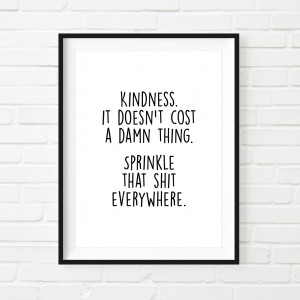
Kindness

Kindness


Happy Friday, friends! We’re going to keep it simple today. Enjoy your weekend!

Categories
Inside My Head

Hey, Jealousy!

Hey Jealousy isn’t just a catchy little Gin Blossom tune from 1989 (the actual year, not the recent Taylor Swift album paying homage to the same year – oof, I feel old. But I digress…). It’s the recognition of a powerful emotion. “Hey, Jealously! Where the hell did you come from?”

Jealousy is a sneaky little feeling that seems most often to come out of nowhere and the poor guy gets a bad reputation. Last week, I was talking with a friend who was having a hard time admitting she was jealous of a colleague. In the telling of a story about this colleague, my friend hesitated and said, “I know it’s bad and I shouldn’t say it, but maybe it’s jealousy?”

But here’s the thing. Jealousy itself isn’t bad. None of the emotions we feel are – we can’t help it. It’s how we feel. It’s what we do about jealously and his fellow emotion friends that can get us into trouble. We’re taught early one to assign judgements to our emotions – it’s good to feel happy, excited or joyful. It’s bad to feel sad, anxious or jealous. And that’s really what gets us into trouble. Our emotions are powerful guides that can help us and we should really cut them some slack when they show up. We need to be less quick to assign a judgement to them and listen to what they’re trying to tell us.

Take our good friend jealousy. He shows up when you see something you want. A colleague gets a promotion. A friend gets married. A cousin takes a trip abroad. If we see these things and want them for ourselves, jealousy can be an exceptionally powerful motivator. What do I need to do to get the promotion? Did I know getting married was that important to me? Should I prioritize a travel fund more than a new car? If we allow jealously to fester and he moves in, gets comfortable and starts making us say mean things to our colleague, wish our friend ill or be outwardly gleeful when our cousin gets food poisoning on her trip, jealousy is bad news. That’s where we get into trouble.

On the flip side, harnessing jealousy and understanding that it’s a reflection of our own values and shifting priorities can be incredibly powerful. In talking about this with another friend, she shared she gets jealous when she’s out and about and sees parents and children having a good time together. She doesn’t get jealous when she sees nice cars or the newest and biggest houses. Having a child is important to her and she doesn’t have one yet – having a nice car and beautiful house are not important to her. She’s listened to jealously and let it help her focus on what’s she’s prioritizing now.

So the next time you notice jealousy popping by to say hello, pay attention to what he’s trying to tell you before you kick him out. He may have a thing or two to share with you.

Categories
Inside My Head Karen

THINK THINK THINK: It does the mind good

On May 1, 2015, I moved to San Diego to launch my business and chase my dream. Reflecting back on these past 10 months, I want to share something that is vital to great decision-making. Ready for it? Here it is:

Every decision deserves time beforehand to think.

Take all the time you want or need. Never under-estimate the value of thinking before executing.

Looking back, I think moving to San Diego was a 2 year process of wrestling with myself about my professional career. I was restless. I was frustrated. I was stressed. And this negative energy provoked me to think differently.

John Fluevog Shoes was a stepping stone; not the destination. Through sub-conscious and conscious reflection I was seeking and searching for my path. When the decision came to give my 6 week notice, pack up my car and move to San Diego, it was a life-giving decision. And 10 months later, and stronger than ever, I believe it was one of the best decisions I’ve ever made.

Wow, I can’t believe I walked off my map! Did I really do this? Yes! I desired it and I wanted it. There was nothing irrational or flippant about it. I chose the path, I chased after it and I still wake up every morning abundantly thankful.

The hurdle was “how do I move to San Diego without a job?” I couldn’t see how it would be possible without a job. And then in November of 2014, I read 30 Lessons for Living by Dr Karl Pillemer and my heart awakened.

Looking back, I think launching my business in San Diego started in 2003! It was January  2003 when I started my first coaching company. I didn’t know what I was doing, but I loved it and knew it was what I was made to do. Then John Fluevog recruited me. Again, I didn’t know what I was doing, but I always had such a passion for business. John took a risk and I loved working with him. I loved every part of my job! And now the two unite: Lifetime Initiatives + John Fluevog Shoes = I’m now ready to live out my purpose fully (Karen Thrall, Inc.).

Was I hasty? No, but perhaps to an onlooker it might look that way.

The thinking I did before making my decision to move was like slow-cooking a great pot of chili! The longer you cook it, the better it tastes.

Taking time to think creates great decisions.

If you’re searching for or sensing a life change, take time to think about it; as much as you can. Go for walks and think. Read books and think. Talk to friends and think. Journal and think. Search the web and think. Explore all your options and think. Imagine different scenarios and think. Let your thinking shape the path you’re on and a great decision will emerge.

Great decisions do not void you of challenges. Oh, you will have challenges, yes. And you’ll also create a powerful foundation of conviction, determination, tenacity, strength, confidence and hope.

Seeing how much I spent thinking about moving to Southern California is now my anchored memory for how important thinking is. The more you think, the better the decision.

I experienced what a great decision feels like! And am the recipient of the positive impact it has had on my life.

– Karen Thrall

* also published on www.karenthrall.com

Categories
Career Libby

Being Bossy

I’ve been reflecting on what it takes to be a good boss. First of all, I know it’s not easy, but it’s probably the most important component of any successful and satisfying career or professional experience. Ask someone about a negative experience with a job and chances are good you’ll get a lot of emotional reminiscing about a particular boss – the memories are still vivid and can evoke stress even years later. I think we all know a “bad” boss when we experience it, but what are the attributes of a “good” one? Certainly it will vary from person to person, but here are a few that I feel are universal:

  1. They respect you. Respect can be shown in a myriad of ways, but it is the one thing that is critical for a successful professional relationship. As a worker, you must feel like your work product is valued and contributes to the goals of the organization.
  2. They see you as an individual. Everyone is different and a good boss will be able differentiate how to interact with each of their staff in a way that works for that individual. It is an important skill to be able to understand how people are motivated and what is important to them – this is where you can find areas of commonality which can strengthen commitment.
  3. They support your professional development. A supervisor who wants your skills to grow is both a sign of respect and a way of telling you that you are a valued member of the team. Not only does it help them achieve their goals, but it makes it more appealing to stay part of the team for a longer time. Insecurity about seeing someone improve their skills – or even learn something the boss doesn’t know – is not conducive to building relationships.
  4. They trust you. Trust is a tricky thing – it has to be earned, but there have to be opportunities given in order for people to show they’re trustworthy…tough! But this is a foundational piece to working with someone, and therefore important to cultivate. In this case, perception is just as important reality.
  5. They listen to you. A professional relationship is not a one-way street. It is critical that a supervisor can listen to, seek out and value your ideas and opinions. If you don’t feel like your views are important, what’s the point?

When you have a truly respectful relationship where both parties feel smart, valued and equitable, the results can be amazing – work can actually be fun! It is important for supervisors to feel secure and to take the time to get to know their staff. When they can model good practices, find out what’s important to you and to be honest, the relationship can grow over time and reap benefits for both parties.

– Libby Bingham

Categories
Awesomeness in the World

Facts vs. Stories

Last week, I talked about the Crucial Conversations training I recently attended and promised (threatened?) I’d be sharing more about it. There was just so much good stuff! In addition to stealing the term human engineering, one of the biggest lessons for me was the idea of fact vs. story. The premise is that facts themselves don’t get our emotions going – it’s the stories we tell ourselves about those facts that really affect us. For instance, if I get a card in the mail from a friend, that’s the fact. Getting the card itself doesn’t make me happy or sad. However, the story I tell myself about why she sent me the card is what makes me happy – my friend took time out of her day to get a card, write a kind message and then mail it to me because I’m a priority in her life. That’s the story. But wait, you say! Couldn’t it be a fact that I’m a priority in her life? Nope. It can be a true story, but it’s not a fact. A fact is something that actually happened. Facts can’t be argued. A story is something I tell myself based on my experience and observations – the context of our relationship, the nice message she wrote inside, that she knew I was having a rough week.

Here’s why this is so powerful to me – it’s so easy to go right to the negative stories. He didn’t return my email because he doesn’t care about my project. I didn’t get invited to the party because I’m not fun. She blew off the meeting because she’s scatter-brained and can’t keep her calendar straight. These are all the negative stories that we tell ourselves and they’re upsetting. To be fair to us poor humans, we’re wired this way – it’s not our fault. Telling stories is how we’ve evolved and how we make sense of the world. Fact: There is a growling sound and a rustling in the bush. Story: Last time I heard this sound and saw a rustling, my caveman friend got eaten by a large cat – I’m getting out of here. Stories keep us safe.

Stories, however, can also be our own downfall. We can easily cast ourselves in stories as the helpless victim and make someone else the villain. This happens in the blink of an eye. But mostly (and I do mean mostly – there are obviously exceptions), people are good and aren’t out to get you. He didn’t return my email because he’s traveling and his phone isn’t syncing with the email server. I didn’t get invited to the large party because the host knows I prefer more intimate dinner parties and she didn’t want me to feel obligated to come. She blew off the meeting because her boss came in with an emergency and she knew we could catch up later.

There are any number of stories we can tell ourselves about one small fact. That’s a helpful reminder to me when I feel attacked, forgotten or frustrated. I can get out of my negativity and ask the other person what’s going on. And that’s really the key – recognize the story you’re telling yourself and then check it out. You’ll stop yourself from getting into a downward spiral of negativity and you’ll get more parts to the story to form to a better understanding of what’s going on. And if there’s a problem and the story isn’t what you want it to be, that’s good news, too. You have the power to rewrite any story you’re involved in.

Categories
Awesomeness in the World Melissa

Thoughts From a Concerning Curator

“The difference between a community and a network is that you belong to a community, but a network belongs to you. You feel in control. You can add friends if you wish, you can delete them if you wish. You are in control of the important people to whom you relate. People feel a little better as a result, because loneliness, abandonment, is the great fear in our individualist age…But most people use social media not to unite, not to open their horizons wider, but on the contrary, to cut themselves a comfort zone where the only sounds they hear are the echoes of their own voice, where the only things they see are the reflections of their own face.”

 I came across Zygmunt Bauman, a Polish sociologist, and his opinion on social media triggered the question of whether I am authentic on the internet, if my social media presence is a true projection of who I am.

Here, on the Creative Community Blog, I strive to be honest, to exercise getting my thoughts into (hopefully) relatable words, and to take a better look at how I’m currently feeling. But outside of writing here, I’ve realized that I might not be authentic on the internet and I’m not too proud of that. I curate the crap out of my Instagram, and my Twitter feed only exists because I heard in a podcast that if you don’t use Twitter in the tech world you’re nobody (ugh, my brain was all “gotta get on Twitter, you’re turning 25 in a few months and what if you have a quarter-life crisis and decide to be in the tech world. You better have a Twitter handle ready in case that happens!”). I don’t use Facebook because it seems stressful to keep up appearances on four platforms as well as in person.

Being a designer makes this even harder. When someone finds me on Instagram, I want all my pictures to share an aesthetic and show that I care about colors, light, and subject matter. All too often, I take a picture of something I find funny and after applying five different filters and playing with the light levels realize that it doesn’t have a home on my feed. This constant curating makes my online presence feel like a brand. It’s taken on it’s own life, and the real parts of my life that I want to share don’t have a home there. And when I take a step back, I feel a bit vapid about the pale pink backgrounds and black and white pictures of people… that’s not showing who I am, it’s showing who I think I have to be.

So how do I navigate out of these waters? I’m one for quotes (not a surprise at this point) since they sum things up so much more succinctly and poetically than I can, so here’s one that helps me put my social media into perspective:

“Authenticity is not needing external approval to feel good about your actions.”

– Kate Arends

I should post the things that make me happy, not the things that will get me the most likes or more followers. My portfolio can be the place for aesthetics and soft lighting, my Instagram (and Twitter and Snapchat) should showcase the tiny moments that are authentic and not always beautiful.

– Melissa Grant

Categories
Libby On the Job

Reorganization

Our department is under renovation – not the fun, pick out paint and wallpaper type. It’s the stressful, difficult reorganizational type.

We have a couple holes where staff have recently left. Getting all the work done is hard, especially alongside lots of new projects and endeavors. But our boss has been very strategic in her approach to filling spots and identifying ways to make the most of things.

It’s exciting but also nerve-wracking – I agree with her approach and think it is a smart way to align what we’re doing with the rest of the organization. But we haven’t been involved with the decision making, and people are thinking, “Where do I fit in?” “Which box is mine?” Additionally, there is the added wrench of one opportunity for a little bit of professional growth. The internal candidates are small in number – more than one vying for one spot. Let the hunger games begin!

I joke, but I do feel like there’s potential for discomfort – what happens after the decision is made? How do the people who don’t get a promotion move forward? How might the overall team dynamic change? Will it be helpful or harmful? How can we ensure a shift like this will be a positive experience for the team? How will this change be managed, and can discomfort be mitigated?

There is a team dynamic at play that could make or break us as a department – I only hope we’re resilient, supportive and flexible enough to embrace the change and make it work for everyone. And while I obviously have lots of questions, I also have lots of hope. I’m looking forward to being a part of these changes and doing what I can to ensure my voice is heard.

– Libby Bingham