
Categories
Career Libby

Back to School

As of this week, summer is officially over. My son has been in school since August 31, but we went on a family trip to the beach last week and now it really feels like the end. It makes me feel a little sad, but I also embrace the seasonal transitions, both personally and professionally.

Personally, I’m getting back into my routine: less cocktailing and more working out, along with less staying up late and more getting up early. Professionally, I need to do the same thing.

September is the start of our fiscal year. We tie our performance reviews to the start of the fiscal year so that we can see whether or not we met our goals for the prior year organizationally, departmentally and individually. I think it’s a decent process – it allows for reflection and a kind of kick start to the new fiscal year…a back-to-school bump if you will!

As I begin to reflect on what my department, and specifically what I, accomplished last year, it’s pretty impressive: we brought in almost $8M in revenue by holding over 150 programs. Out of that 150, twenty-one of them were my programs – all face-to-face and some lasting 2 hours, others 5 days…not too shabby for a part-timer. (I won’t say that I contributed significantly to the revenue numbers, but I helped!)

I think it’s important to periodically check-in with yourself and review your body of work. Work can sometimes feel like, well, work, so understanding all that you’ve accomplished is essential to maintaining forward progress and staying energized. It’s okay to be proud!

You should also be able to articulate your role on the team. While your individual successes are what make you shine, your part in elevating the entire department or in helping the organization meet their goals is what makes you valuable. Together, these are the things that keep you employed, but they are also the recipe for increasing your own self-esteem and a metric for whether or not this job is still the right fit for you.

– Libby Bingham
Categories
Career Libby

Be a Rockstar

As I write this, I sit in the common area of my son’s music school, the School of Rock. There’s a video of various student performances playing, a private lesson or two going on in the rooms behind me, teens plucking away on their guitars while they hang out eating snacks and my son’s “band” doing their best to rock Seven Nation Army – cacophony! But amazing – how many of you are brave enough to get in front of an audience – even a small one – and do something that you’re not 100% sure that you’re terrific at? And you’re only seven, or eleven or fourteen? It’s pretty impressive, isn’t it? I’m inspired to think about how we can all be rockstars at work:

  1. Try. As we get older, we sometimes forget to try something new – it’s too embarrassing to take a crack at a presentation or the creation of a program description without being sure that we’ll succeed. You know what? It’s still okay to try. What’s the worst that can happen? You’ll still have your day job!
  2. Take a back seat. This is a strange one if I’m telling you how to be a rockstar, but letting other people shine is what makes a really good band. By allowing your own talents to support someone else’s makes everyone better – just as Jon Bon Jovi would be nothing without Richie Sambora or Steven Tyler just odd looking without Joe Perry, your CSE or boss is nothing without your kicka** talents and efforts at budgeting, marketing or meeting planning. Own your place in the band.
  3. Rock your solo. When it actually becomes time for you to take your solo, go for it – Angus Young it on the floor, freak out like Flea, channel Neal Pert – and give it your all. Don’t phone it in, really make it count: prepare, practice and crush it.
  4. Practice. Despite various mythologies and seven year old fantasies, no real rockstar ever made it by just picking up a guitar and starting to play – it takes years of practice, hours of repetitive exercises and the like. If you’re new to the game, respect your elders – they’ve been doing scales and chord work for a long time…you can learn something from them. And you who have been at it a while – doing the road tours and setting up your own gigs – don’t forget what it’s like to have a fire in your belly; give them some space to try (see numbers 1 and 2).
  5. Have fun. Some of us have Very Important Jobs. Some have less cachet. But we all have people depending on us to perform some duty and we’ll all do better if we’re having fun while we’re doing it. You know those bands that totally gel? The ones who have been together forever? It’s mostly because they’re having fun. You should too – the band will be stronger for it!

– Libby Bingham

Categories
Libby On the Job

There’s No Place Like Home!

Earlier this week, I arrived home after almost one month away from home.* I’ve lived overseas before and I’m not afraid of a road trip or extended vacation, but this time, coming home was even sweeter than it usually is. I’ve been thinking all day about what the difference is and I’ve come up with this:

  1. Routine. As an adult with a family, routine is the thing that makes it all work (relatively) smoothly – without routine, things are a lot more difficult! I loved the variety of family cultures we experienced on our trip, but I missed mine. At work, routine is the thing that can help keep the train from going off the track – if you have a routine, getting thrown that last minute project won’t generate as much angst.
  2. Familiar responses. While I know all the folks we stayed with, there were still times I was unsure of the best way to approach a subject or answer a question about politics or other delicate topics. It’s nice to be at home where I can speak my mind and not worry about whether or not my husband is going to have an adverse reaction to some statement I make. At work, it’s nice to know who your go-to co-workers are, that you have to give the marketing team chocolate if you want something done faster, that the facilities folks love your jokes or that a burger and beer can move your IT project to the top of the list!
  3. Showering is better at home. Actually, there were some places that had much nicer showers, and some that did not. It wasn’t the actual shower, but it was nice to be able to take it whenever I want without worrying about interfering with someone else’s routine or using up the hot water or not having access to all my lotions and potions. At work, it’s nice to have your own space where you know where everything is and you know how everything works – even with a wonky computer or printer, you know how to make it work like the Fonz, and that makes you a hero.
  4. My stuff. Oh, I brought plenty with me (too much, my husband would say) and I didn’t really miss anything I left home, but when I got back, I was just happy to see my stuff. My son spent several hours getting reacquainted with his stuff, checking out books, baseball equipment, rocks and Pokemon cards. He is delighted to just see his stuff again. At work, your “stuff” are all your projects – papers you have written, documents you’ve created, clients you’ve helped – it’s nice to reminisce a little bit and get reacquainted with your past accomplishments. They’ve helped you get where you are; they may also inspire a fresh perspective or creative idea.
  5. Sleeping is important. I had some VERY comfortable sleeping arrangements on this trip, but I was awoken more than I am at home. My son was often in another room with other kids and in the middle of the night, he’d get freaked out or have a little asthma attack or just miss me, so he’d come to visit. Vacationing and working at the same time is hard to do, but doing it with interrupted sleep was extra tough. There were many nights when I was going to come back to hang out with the adults after bedtime but I usually ended up falling asleep. At work, it is important to get rest – don’t be a martyr! If you’re tired from being the first one in and the last one out, you’re probably not doing your best work. Be kind to yourself – take a break, get some good sleep, live your life. It’ll all be there tomorrow after you’ve gotten some quality shut-eye.

*Thanks to all my family and friends (who are like family) who hosted me and Joey – we loved seeing you and spending time together…it was a terrific experience for both of us. You’re welcome here any time!

– Libby Bingham

Categories
Career Libby

Being a Good Guest

I am on a “working vacation” for the month of August – I am taking my seven-year-old son on a road trip to visit family and friends throughout New England*. While he and his cousins enjoy swimming, running, biking and playing, I continue to work remotely with pools, ponds, mountains and meadows as my office view. We are nomadic, staying anywhere from two nights to a week in each place. Along the way, I’ve picked up some tips on being a good guest that I think translate really well to the work place.

  1. Pick up after yourself. When you don’t have any place to put your stuff, it can start migrating all over the place. Not only is that inconsiderate of the people who live there, but it makes it harder to pack up and you can lose stuff in the process. At work, keep your workspace neat and tidy – it shows respect for your co-workers and makes it easier to respond to them when they need something from you.
  2. Help with the chores. While you are a “guest,” you are also family! You are not there to be waited on – pitch in and help with the dishes, the laundry, weeding or childcare. Not only does it build a stronger bond and sense of community, but if you don’t, it can lead to resentment and a less pleasant environment. At work, if you’re not too busy or have finished a project, look around and see who else needs help – this not only strengthens your team, but it will come back to you next time you’re in a crunch.
  3. House rules. We have a lot of rules for our son – and they are not always the same at every house we visit. While some are non-negotiable (no-hitting, no stealing, no knocking over of Mommy’s cocktail), there is a need for flexibility. If something is a no-go in that house, it applies to my son, too; if they are allowed to do something that he normally would not be (we’re talking extra sweets here, not R-rated movies and cigarettes), it’s okay to loosen the reins and let him have that experience. It is more fun for everyone and I am often surprised how well he navigates a different routine or set of rules. At work, the way you do something is not the only way to do it – people have different ways of working or accomplishing a task – try letting go of the how and focusing just on the results.
  4. Ask for what you need. The people hosting you want you to be comfortable (not too comfortable, see #2 above!), but they don’t always know what you need. Do you prefer a certain type of milk or yogurt? Let them know next time they go to the store. Does your kid need to go to bed early? Say goodnight when it’s the appropriate time. Do you need to do some laundry? Ask if you can throw some things in next time they do a load. If you don’t let people know what you need in order to have the best experience and settle in to their routine, it can become a bit awkward – negative or uncomfortable energies are easily picked up on! At work, if you need help, ask someone – you may need extra resources, more time or a hand with something. If you don’t ask, your boss will still pick up on your less-than-positive energy but won’t know why and that can lead to all sorts of communication problems. Articulating what you need makes things clear, allows others to participate in finding a solution, and still lets you shine.
  5. Don’t forget to pick up the check. One of the nice things about a trip like this is that it can really reduce the cost of hotels and eating out – this is a good thing! However, it’s not free: you are adding costs to your hosts like a longer grocery list, a higher energy bill and a bigger laundry load. Be cognizant of their expenses and try to contribute where you can – do the grocery shopping sometimes or chip in for their weekly expenses. Take the kids out for ice-cream or a trip to a local activity, and definitely take them out to dinner at least once while you’re there – it’s a nice way to say thank you and no one has to cook or clean. It can be a vacation for everyone! At work, it is important to share the spotlight – chip in on others’ recognition and participation, share the credit for a project you worked on, let them work with the best volunteer – ensuring that they get some of the good stuff helps your office experience be a little less like work and just a wee bit more like vacation.

– Libby Bingham

*Connecticut, New York, Vermont, New Hampshire, Massachusetts and back to Connecticut in 25 days by car! [Editor’s Note: Libby is a brave, brave woman!] 😉


Categories
Career Libby

Time to Move On

My brother is a commercial diver by trade (helmets not tanks). He has been diving for almost twenty years and working for the same company for the past seven. Last week he just up and quit. He was reluctant to tell my parents and me and my husband about it, feeling it was an irresponsible move, but he did finally tell us. Here’s our collective take on things:

  1. Always do your best. This is something instilled in both my brother and me from birth and the message is usually delivered as, “Don’t do a half-assed job.” When whatever your co-workers or company is doing impedes your ability to do your best, it’s time to move on.
  2. You can’t change other people. You can only change yourself and how you receive other people’s interactions with you. If you’ve done all you can to adapt to the inane behavior of others and they continue to encroach on your sanity, it’s time to move on.
  3. Safety is no accident. This is true no matter what, but when you’re on a boat in the middle of the ocean responsible for the lives of a five man crew, it transforms from catch phrase to survival tactic. My brother would never be considered lackadaisical, whimsical or frivolous. If he asks you to do something on his boat, you do it or risk an injury to yourself or others. If you’re working with people who do not value your health and well-being, it’s time to move on.
  4. Loyalty is a tricky thing. Loyalty is something you want in a business environment – some level of trust and comfort allows people to settle in and do their best work. It is helpful when building a team and growing an enterprise. But it must also be paired with buckling down, looking out for the company interests and a subordinated ego. If your boss chooses a slacker crony over your hard work and productivity, it’s time to move on.
  5. Your reputation will proceed you. If you work hard, do your best, act in the best interests of the company, and behave like a brand ambassador at all times, people notice you. And if you’re one of the few people behaving this way in your organization, they will notice you even more. If your principles are being compromised, it’s time to move on.

When you have a tried and true work ethic, when you have spent years gaining experience and expertise, when you have treated all your co-workers – those both above and below you in the organization chart – with respect, you can move on. Something else will come along. It would be ideal to have something planned before making a move, but life doesn’t always work like that. Though if you behave in such a way that people want to be associated with you, you won’t have any worries when you finally say, “Enough is enough. It’s time to move on.”

(P.S. Within a week of quitting his job, my brother got a new full-time job, a part-time job AND an offer for a seasonal job. He’s fine and we’re all very proud.)

– Libby Bingham

Categories
Career Libby

Making the Pitch

Last week, I was asked to present an idea about moving a beloved face-to-face (f2f) program to an online format. I was actually quite nervous about it, but my boss assured me that it was a casual situation and I only needed to talk for five minutes. Here’s what I learned:

  1. It is a fantastic opportunity to be able to present my idea to decision makers before spending a lot of time on a written proposal. That isn’t to say I didn’t do a lot of homework beforehand but since it was verbal, I didn’t worry about typos!
  2. Five minutes is not enough time! It is important NOT to rush through your pitch. If people are going to be green or red lighting your project, you need to present them with all the relevant information for them to make that decision. For me – taking an existing program and radically changing it – it was important to give them some history, an idea of my level of involvement and expertise, and an understanding that I’d thought through the majority of angles and considerations. While this took more time upfront, it allowed them to focus on the whole picture rather than the details that can make things sticky moving forward.
  3. No matter how well you know the subject matter, smart people can add value. Even not-so-smart people have their contributions to make! By talking through an idea out loud and with the necessity of answering questions right then and there, you can be assured (or not) of the soundness of what you’re trying to do, and make it even better.
  4. The small stuff does matter…at least in an implementation phase. Being aware of what other stakeholders are concerned about (How will this affect me?) up front, leads to more diplomatic approaches when sharing information. Indeed, they can be presented as opportunities and can get people excited about change, even if it encroaches upon their comfort zone.
  5. Be open-minded. It’s hard to distance yourself from a project that you’ve worked long and hard on, and when people offer criticism or question the value, it can be hurtful – if you let it. But if you approach it from the viewpoint of thinking through all the angles before investing time and money, you are less likely to personalize it and more likely to be successful. Assume people want to help you, not impede you!

I am not a fan of process when it comes to innovation (too many rules!), but having an arrangement where open, honest and constructive questions and feedback can be shared at a very early stage, can lead to much sounder outcomes. If you make the pitch the right way, you may find yourself with a lot more support than you ever thought possible.

What will you pitch today?

– Libby Bingham

Categories
Book Reports Libby

The Year of Magical Thinking

Last week I received a call from a friend, the mother of my son’s friend. Her son, who had just turned seven years old, died. He got sick, was hospitalized and while in the care of doctors, had a brain hemorrhage and died.

On so many levels, for so many reasons, I am heartbroken.

I am doing my best to navigate the murky waters of being a friend and, at the same time, a reminder of what she and her husband have lost. I am trying not to be sad all the time. I’m talking to people in order to process it while trying hard not to make this about me.

A friend of mine – who lost her mother to a long bout with brain cancer – recommended to me that I read Joan Didion’s The Year of Magical Thinking, a book looked upon as a classic take on mourning.

The book was hard to read; Didion lays all her emotions bare. And while it does not specifically address the death of a child, many of the things she goes through are universal. One thing stuck out to me: it was just an ordinary day.

That phrase is terrifying – there is no advance notice of death. Even if someone is sick for a long time, the actual passing is still difficult; without time to process, it’s devastating. You cannot prepare.

It can also be a comforting phrase – this means that every day is a special day when you spend it with people you care about. It’s an opportunity to make a memory, build a relationship, or share an experience. And in mourning, the most ordinary of things are the things you remember – and miss – the most.

I will continue to be sad, but I will also stop lamenting that every day is not a rainbow of fun, sunshine and candy. I will embrace the ordinariness of the everyday, because I have commonplace, I have mundane, I have one more day.

– Libby Bingham

Categories
Awesomeness in the World Libby

Rumer Has It

I recently was gifted a Glamour magazine (July 2015) – not my usual fare, but I found some real value in it: negotiation tactics, pastels are in this summer, and Rumer Willis is kind of awesome. I missed the season of Dancing With the Stars (DWTS) where Rumer won the coveted disco ball, but I wish I hadn’t – her article (Dancing Queen) hit on some things that I’m still trying to learn a whole quarter of a century after she’s gained the insight:

  1. “Comparison is the thief of joy.” This Teddy Roosevelt gem is something that Rumer’s mom, megastar, Demi Moore, told her when she was growing up. It’s a good one – there’s always someone smarter/richer/prettier/funnier/more successful than you are; if you spend all your time lamenting whatever you are not, you’re wasting a lot of time being unhappy. Find your awesome and embrace it!
  2. “Fear is a really debilitating emotion.” Being scared of failing, looking the fool or not being “enough” can keep you from enjoying your life and trying new things. Rumer overcame her fear enough to go on national TV to do something she’d never tried, she of no dance or athletic background (“…or even worked out much…”). Oh, and she won.
  3. Inspiration can be found lots of places. Scout and Tallulah, her little sisters, both inspire her to turn down the negative noise – their bravery has helped her ignore a constant barrage of nasty comments on the Internet. I don’t know Scout and Tallulah, but I have found a little inspiration in Glamour magazine!
  4. Beauty is in accomplishment. Rumer talked about how beautiful she felt after having completed her first competition dance – not because of the pretty costume or having her hair and make-up done, but because of how hard she’d worked and having overcome her fears. This has led to a stronger sense of believing in herself.
  5. Stop being mean. This is something that almost every child has heard, but as adults, we sometimes forget. In the age of Internet anonymity, cruelty has become easier, but it hurts just as much. Think of what we could all accomplish if we stopped being mean and started being supportive. If you can’t think of something nice to say, don’t say anything at all!

– Libby Bingham

Categories
How to be Awesome Jams Libby

Inappropriate Children’s Songs

Every parent finds themselves uncomfortable with a song their child has heard or gravitated to…they can be a source of questions that are particularly difficult and embarrassing to answer. I am no different, but here is a list of songs that my seven year old son has either misheard or misinterpreted the lyrics. Try listening to them with an alternative take in mind…you’ll get a giggle!

  1. Another One Bites the Dust [Queen] Okay, so I don’t know for sure, but believe this song is about gang riots or something…really not appropriate for a kid, but try not laughing when he earnestly sings “Another One Busts the Dust.” A vacuum cleaner is something we really don’t celebrate enough, right?
  2. Sugar [Maroon Five] The innuendo in this song is ridiculously inappropriate for children, but the literal ode to sweetener is totally appropriate for a seven year old. It’s a true love, a pure love. Delicious.
  3. TNT [AC/DC] This is another song that has a level of innuendo that is difficult even for adults to embrace (!), but when Joey sings it, it becomes a personal power anthem. Power is something that a kid has very little of, so having a way to articulate it is an awesome thing to watch.
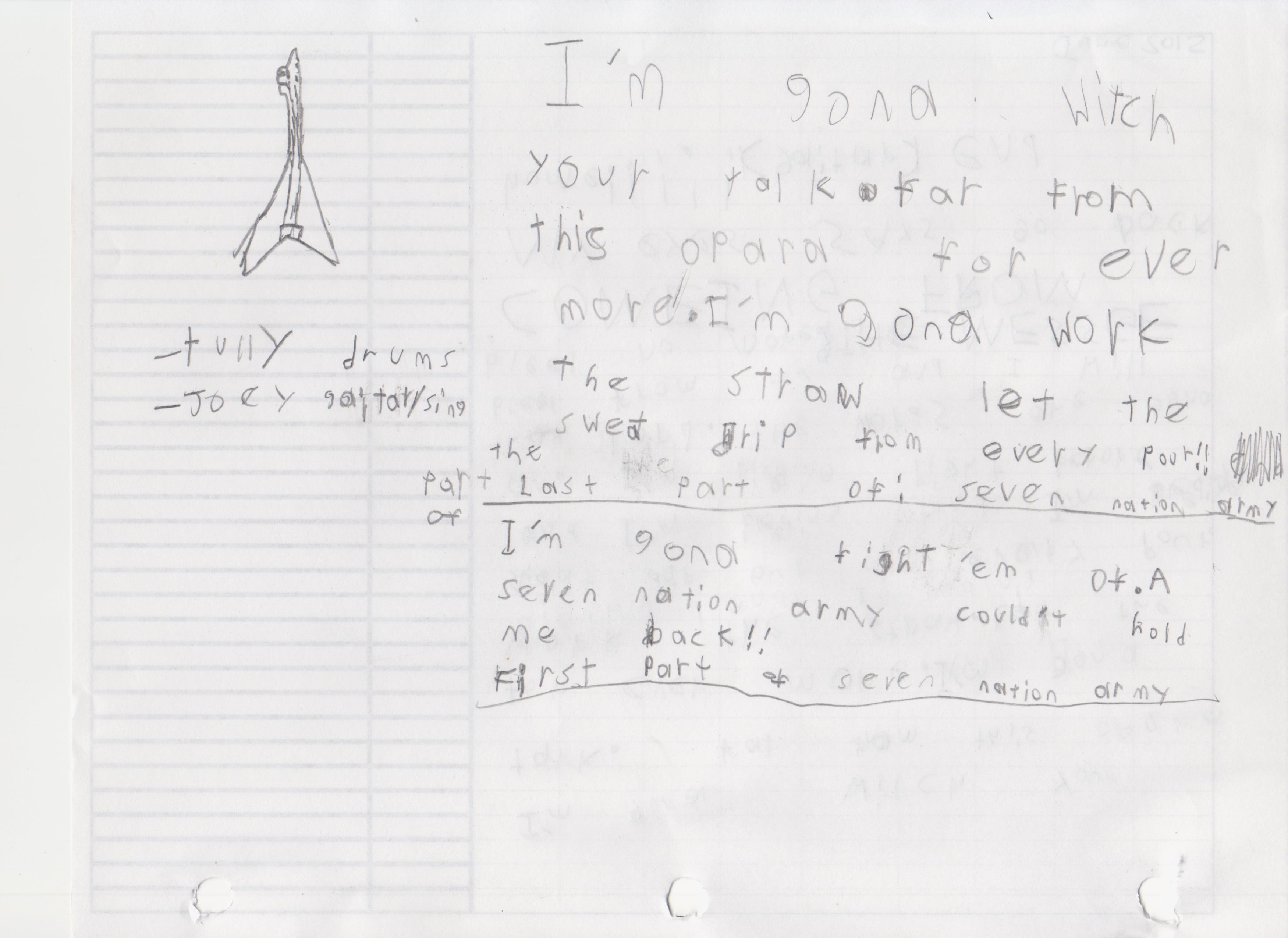
  4. Seven Nation Army [White Stripes] Joey is learning how to play the guitar and this is his go-to song. Honestly, I’m not sure what the song is about (other than it is a play on the Salvation Army), but I don’t really care. Why? Because Joey has no idea what the words are and what it means – all I know is that he loves to sing it when playing the guitar and that it’s adorable. And on top of that, he has written out the lyrics for when he and his eight year old cousin form their band this summerLibby Post
  5. You Can’t Always Get What You Want [Rolling Stones] I love it when Joey says, “Mom! This is my theme song!” We have used this as a mantra to avoid temper tantrums when he was little, and now he’ll actually ask us for what he might “need” if he can’t get what he wants. Rockin’ AND effective!

– Libby Bingham

Categories
Awesomeness in the World Libby

Personal Training Wisdom

So, I bit the bullet and decided to hire a personal trainer at my gym – I really think having that extra push is necessary for me as I make the effort to change things up in my life. It doesn’t hurt that Joseph is super nice and, well, hot, but he’s also smart…I thought I would share some of the wisdom from our sessions.

  1. Innovation is good. We already know that innovation is the buzz word of the century, but Joseph applies it to training and it totally makes sense. I’m not getting anywhere doing the same thing I’ve been doing – I need a different approach, a do-over, a new start. He is creating innovative workouts that continually changes and keeps my body guessing – it never knows what to expect! It also keeps me from getting bored.
  2. Try slowing down. So on top of being super nice and very fit, Joseph is also an app designer – he’s working on an app that will help runners train or that can help newbies get started. He recently told me that they’re making a lot of progress but also encountering a lot of bugs so he recommended to his partners that they slow things down. This is excellent advice for everybody – take your time! If you’re not rushing through things, you’re less likely to make mistakes, waste money, or get hurt, while at the same time, more likely to learn something and make real progress.
  3. Little things mean a lot. 0-60 is great for engine performance, but progress in life is much more incremental. Instead of adding 10lbs to my bar every time I lift weights, it is better for me to tack on one or two repetitions to every set. Today I told him that I don’t seem to have lost any weight but my pants are fitting better and I went up a notch on my bra strap…I got a “way to go” AND a high-five! It’s not necessarily a lot (those pounds are stubborn!) but it is progress and any positive change should be celebrated.
  4. Keep your head in the game. One of the reasons I like working with Joseph is he understands that – for me – the idea of working out is mostly mental and emotional. It’s not enough for me to sweat, lift the weights or do the crunches, I have to truly believe that the effort I put in will make a difference, that I deserve to be healthy and that I am able to stay the course. If you can get your head in the right place – whatever you’re taking on – that’s more than half the battle.
  5. Lists are good for blogs! According to Joseph, who has a friend who is a professional blogger, lists are the way to go for blogs – much easier for the reader. So, expect to see more lists in the future…you’re welcome!

– Libby Bingham